

Permanent hair removal is now at the forefront of many technological innovations. Behind every device and method are years of scientific research aimed at better understanding hair biology and improving treatment effectiveness.
For several decades, Dectro International has actively contributed to advancing this field by conducting research and collaborating with scientific centers to develop increasingly precise and high-performance electroepilation technologies. This work has also been published in the prestigious British Journal of Dermatology.
Among the most widely studied approaches in permanent hair removal today, two technologies stand out: photoepilation (laser and IPL) and electroepilation. While both aim to reduce or eliminate hair regrowth, their mechanisms of action are based on different scientific principles.
Electroepilation and photoepilation: two different approaches
Although both electrolysis and photoepilation aim to permanently reduce or eliminate hair regrowth, they rely on distinct principles.
Photoepilation works through light energy that targets the melanin in the hair to generate heat and weaken the hair follicle. This method can deliver good results in certain cases, but its effectiveness largely depends on two factors: hair color and skin type. Dark hair on light skin typically responds best, as the contrast allows the light energy to be absorbed more efficiently by the melanin. In contrast, very light hair (blonde, red or gray) contains little pigment and responds less effectively to this type of technology.
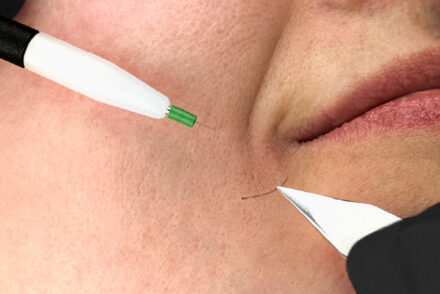
Electroepilation, on the other hand, works directly within the hair follicle. An ultrafine probe is inserted into the natural canal of the hair (hair follicle) to deliver controlled energy that destroys the cells responsible for regrowth.
Because this method does not rely on melanin, it can permanently treat all hair types, including blonde, red and gray hair, while also providing a safe treatment for all skin tones.
Over the decades, technological advances and scientific research conducted by Dectro International have significantly improved the precision, speed and comfort of electroepilation treatments, making it a benchmark in permanent hair removal.
27.12 MHz Radiofrequency and Apilus innovation
To better understand the mechanisms involved in permanent hair removal, Dectro International has conducted several scientific research programs in collaboration with Université Laval and the LOEX Research Center in Québec City. These studies have examined hair regrowth as well as the effectiveness of various hair removal technologies, including laser, IPL and radiofrequency electrolysis.
The results have highlighted the advantages of using high radiofrequencies, such as 27.12 MHz, in electroepilation treatments. This frequency allows energy to be delivered more quickly and more precisely within the hair follicle, helping to more effectively destroy the cells responsible for regrowth, reduce treatment time and improve client comfort.
These advancements have also enabled Dectro to develop new, more efficient hair removal methods on Apilus devices, optimizing energy delivery within the follicle.
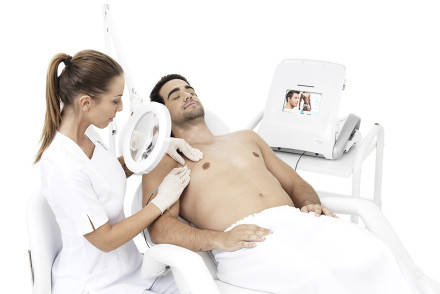
Building on these innovations, Dectro International launched the Apilus xCell in 2014, a next-generation device using 27.12 MHz radiofrequency. Equipped with a touch screen and advanced intelligence, it offers nearly 29,700 treatment programs that take into account various parameters, such as probe type, body area and hair characteristics.
The Apilus xCell also integrates unique and high-performance modes such as Synchro (patented), SynchroBlend and MeloFlash, allowing treatments to be fully customized and optimized while providing professionals with increasingly precise, fast and comfortable solutions.
The future of permanent hair removal
Today, the evolution of permanent hair removal technologies is based on a fundamental principle: innovation must be grounded in science. Thanks to years of research, particularly by Dectro International and its scientific partners, professionals now have access to increasingly precise, fast and high-performance technologies.
The use of 27.12 MHz radiofrequency is a clear example of this progress: a science-driven technology that enhances treatment effectiveness while improving client comfort.
As technologies continue to evolve, research remains at the core of developing ever more advanced solutions in permanent hair removal.
To learn more about scientific studies on 27.12 MHz radiofrequency and photoepilation conducted in collaboration with LOEX: https://www.dectro.com/fr/recherches-scientifiques




No Comments